


① Quick Answer
Professional walkie talkie etiquette uses short procedural words, call signs, plain-language messages, and the 26-word International Radiotelephony Spelling Alphabet. Terms such as Over, Out, Roger, Wilco, Say Again, and Stand By have specific functions. Ten-codes may be useful inside one trained organization, but they are not universal; for multi-agency or multinational work, define every code in the communications plan or use plain language.
② Key Takeaways
- Over ends a transmission and invites a reply; Out ends the exchange and does not invite a reply. They normally should not be combined.
- Roger means the last transmission was received; Wilco adds that the instruction will be followed. Copy is common operational shorthand but may not be part of every formal procedure manual.
- The international spelling alphabet contains 26 code words, from Alfa to Zulu. The ITU lists it in Appendix 14 of the 2024 Radio Regulations.
- Ten-codes vary by organization. CISA’s interoperability guidance recommends plain language for multi-agency, multi-jurisdictional, and multi-discipline incidents.
- CTCSS and DCS filter which transmissions open a receiver’s squelch; they do not encrypt speech or make a shared radio channel private.
- QYT can write a customer-supplied frequency table before shipment and can configure analog CTCSS/DCS settings, according to the company’s 2026 product FAQ.
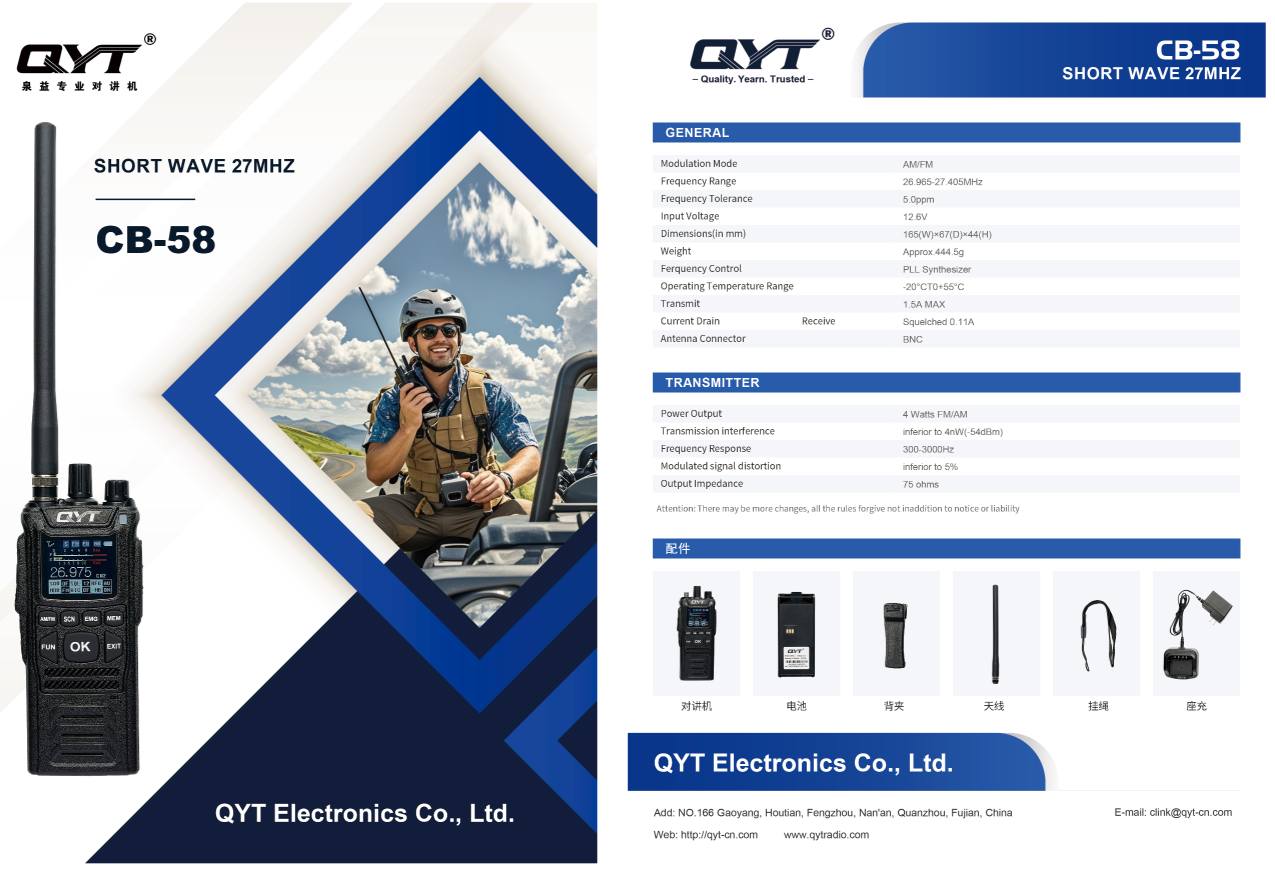
Product example: the QYT CB-58 specification sheet identifies AM/FM operation across 26.965–27.405 MHz with up to 4 W output. Operating permissions and channel rules depend on the destination market.
③ What Are the 10 Essential Walkie Talkie Phrases Every User Must Know?
Most handheld two-way radios use push-to-talk, half-duplex operation: one operator transmits while the others listen. A disciplined call therefore identifies the receiving station, identifies the sender, delivers one concise message, and clearly hands back or closes the channel.
Official New Zealand search-and-rescue training defines radio discipline around Accuracy, Brevity, and Clarity and states that procedure words are used to improve accuracy and clarity while keeping messages brief (NZ Search and Rescue, Radio Voice Procedures).
A useful call pattern is: “[Called station], this is [your call sign], [message], Over.” Do not begin speaking before the channel is clear, and avoid transmitting personal, medical, security, or commercially sensitive information on an unencrypted channel.
④ What Are 10-Codes and How Should Teams Use Them?
Ten-codes are compact numerical labels used by some dispatch organizations. Familiar examples include 10-4 for acknowledgment and 10-20 for location, but meanings vary between agencies and regions. They should therefore be treated as local SOP vocabulary, not as a global radio language.
This distinction has direct safety consequences. CISA’s plain-language guidance describes how the same code can carry different meanings between agencies and states that plain language is required for multi-agency, multi-jurisdictional, and multi-discipline incidents. The guidance was developed with a working group of more than 40 public-safety stakeholders (CISA Plain Language FAQs). The current National Interoperability Field Operations Guide likewise states that 10-codes lack the universality needed for multi-agency incidents (CISA NIFOG).
Which 10-codes are commonly encountered?
Recommended policy: a single-company security or logistics team may use a short approved code list after training. If outside responders, port authorities, contractors, or medical teams join the channel, switch to plain language.
⑤ What Is the NATO Phonetic Alphabet for Radio Communication?
The official name is the International Radiotelephony Spelling Alphabet, although it is widely called the NATO phonetic alphabet. It assigns one distinctive word to each of the 26 English letters so names, call signs, serial numbers, coordinates, and vehicle registrations remain understandable across noise and accents.
ICAO reports that the alphabet was tested with speakers from 31 countries before the final international version entered aviation use. The ITU’s 2024 Radio Regulations, Appendix 14, contains the phonetic alphabet and figure code used in international radio work (ITU Radio Regulations 2024). ICAO explains that the system was designed so voice messages could be understood regardless of native language, especially where navigation or personal safety is involved (ICAO Annex 10 history).
Example: “Vehicle plate Bravo–Echo–Seven–Zero–Niner.” Use digit-by-digit pronunciation when accuracy matters.
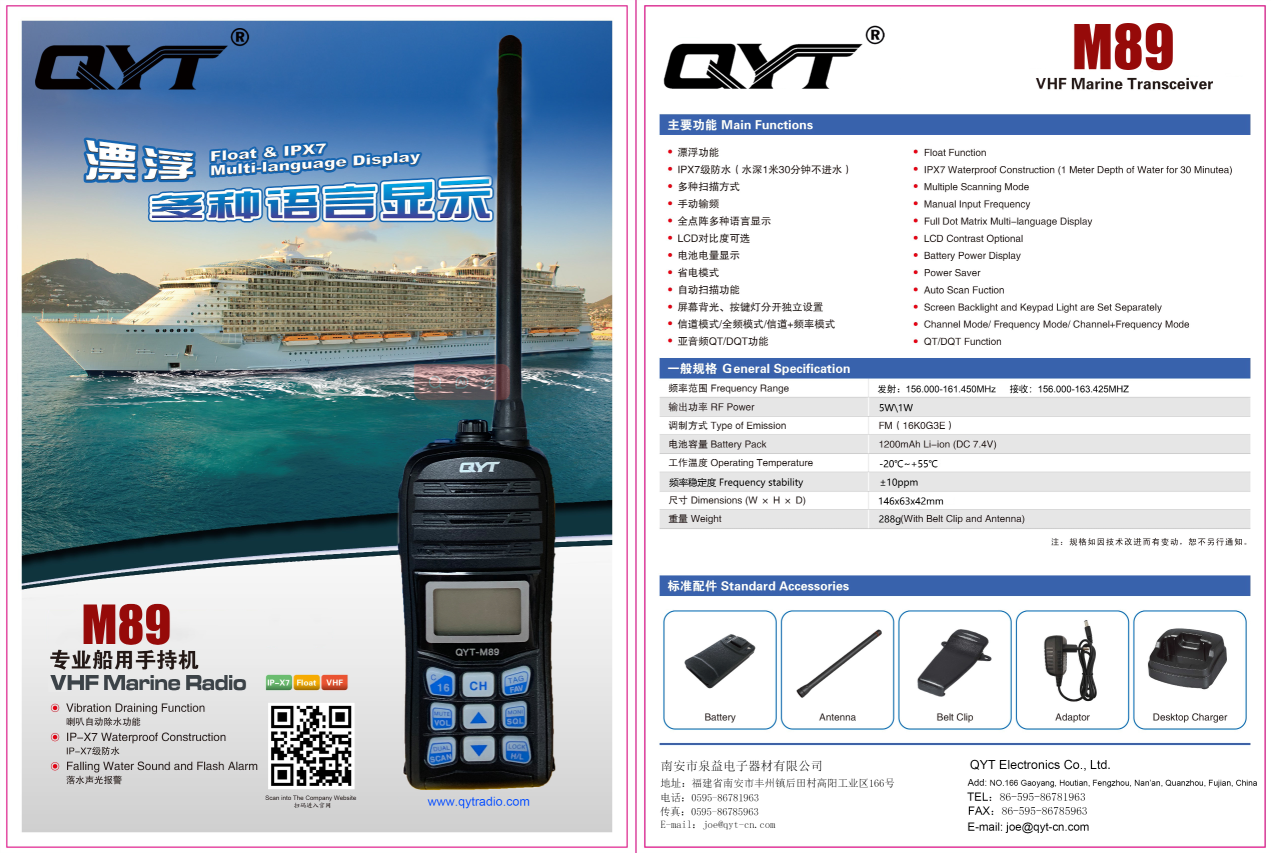
Product example: the QYT M-89 marine handheld operates on international marine VHF frequencies (TX: 156.000–161.450 MHz, RX: 156.000–163.425 MHz) with 5 W output, IP67 water ingress protection, and a floating chassis. Shipboard communications, distress watches, and calling procedures must comply with ITU maritime Radio Regulations and vessel operating instructions.
⑥ What Do Roger, Wilco, and Copy Mean on a Walkie Talkie?
These terms are related but not identical:
Civil Air Patrol’s radiotelephone regulation emphasizes that standardized prowords improve accuracy and clarity, while individual organizations may still use different procedures. It also states that “Roger” is already implicit in “Wilco,” so “Roger Wilco” is redundant (CAPR 100-3, Radiotelephone Operations).
⑦ How Do Professional Security, Logistics, and Maritime Teams Use Radio Protocols?
Professional operations should build the protocol before distributing radios:
- Create call signs and a channel plan. Assign clear roles such as Control, Gate One, Medical, Loading, Bridge, and Engineering.
- Write a one-page SOP. Define approved prowords, any local 10-codes, emergency wording, escalation rules, and restricted information.
- Use plain language across organizations. CISA recommends mapping who must communicate with whom, documenting the plan, conducting dry runs, and updating the plan after the operation (CISA Planned Events Communications Guide).
- Train for noise. OSHA’s occupational-noise standard uses 85 dBA as an 8-hour time-weighted action level. At this threshold, teams should combine hearing protection, compatible earpieces, clear call signs, and short transmissions rather than relying on louder audio alone (OSHA 29 CFR 1910.95).
- Treat CTCSS/DCS correctly. These tones keep the speaker muted until the matching code is detected. Other users on the same frequency may still interfere with or monitor the transmission; use approved encryption or another authorized secure system when confidentiality is required.
A practical reminder comes from Sergeant Robert Sisley in CISA’s planned-events guide: “The main objective of interoperable communications is to provide human interoperability… Don’t overcomplicate things when you don’t have to.”
For procurement teams, QYT’s radio range can be supplied with customer-requested frequency programming. QYT’s 2026 internal product FAQ confirms that customers may provide a frequency table for factory programming and that analog CTCSS/DCS settings can be configured for compatible radios. QYT also offers branded or neutral packing as described on the QYT company page.
⑧ How Should a 100-Radio Event Team Be Deployed?
The following is an evidence-based implementation template—not a claimed customer case—because no supporting QYT case record was found for the original “100-unit event security order” statement.
⑨ How Should a Cruise or Maritime Team Structure Radio Etiquette?
A vessel should separate bridge, deck, engineering, housekeeping, and emergency traffic according to its authorized communications plan. Crew members should use call signs and the international spelling alphabet for cabin numbers, equipment identifiers, and names. Distress and urgency procedures must follow the vessel’s approved maritime rules; local 10-codes should not replace internationally recognized safety language.
Where crew members speak different first languages, training should assess whether each person can complete three tasks: identify the called and calling stations, spell a mixed letter-number identifier accurately, and deliver a location plus incident description without coded ambiguity.
⑩ Frequently Asked Questions
What does “Over and Out” mean on a walkie talkie?
“Over” ends a transmission and requests a reply; “Out” ends the exchange and requests no reply. Because those instructions conflict, disciplined operators normally use one or the other. Follow the procedure manual adopted by your organization, vessel, or incident command.
What is the NATO phonetic alphabet?
The International Radiotelephony Spelling Alphabet assigns 26 code words—Alfa through Zulu—to the English alphabet. ICAO and ITU use it to reduce confusion when letters, call signs, names, and identifiers are transmitted through noise, interference, or different accents.
Are 10-codes universal on walkie talkies?
No. Meanings vary by agency and region, so 10-33 and other codes may not mean the same thing to every team. CISA recommends plain language during multi-agency, multi-jurisdictional, and multi-discipline incidents. Use codes only when the shared SOP defines them.
How should security staff use a walkie talkie?
Security staff should identify the called station and themselves, speak briefly, use approved call signs, and report the location before incident details. They should keep sensitive information off unencrypted channels and switch to plain language whenever outside responders join the communication network.
Why do operators say “Roger” on a walkie talkie?
“Roger” confirms that the last transmission was received satisfactorily. It does not mean the operator agrees or will act. “Wilco” means the message was received, understood, and will be followed; saying “Roger Wilco” is therefore redundant in standardized voice procedure.
Do CTCSS and DCS make radio conversations private?
No. CTCSS and DCS control receiver squelch, helping a team avoid hearing unwanted same-frequency traffic. They do not encrypt speech, prevent interference, or stop another compatible receiver from listening. Confidential traffic requires an authorized secure communications method.